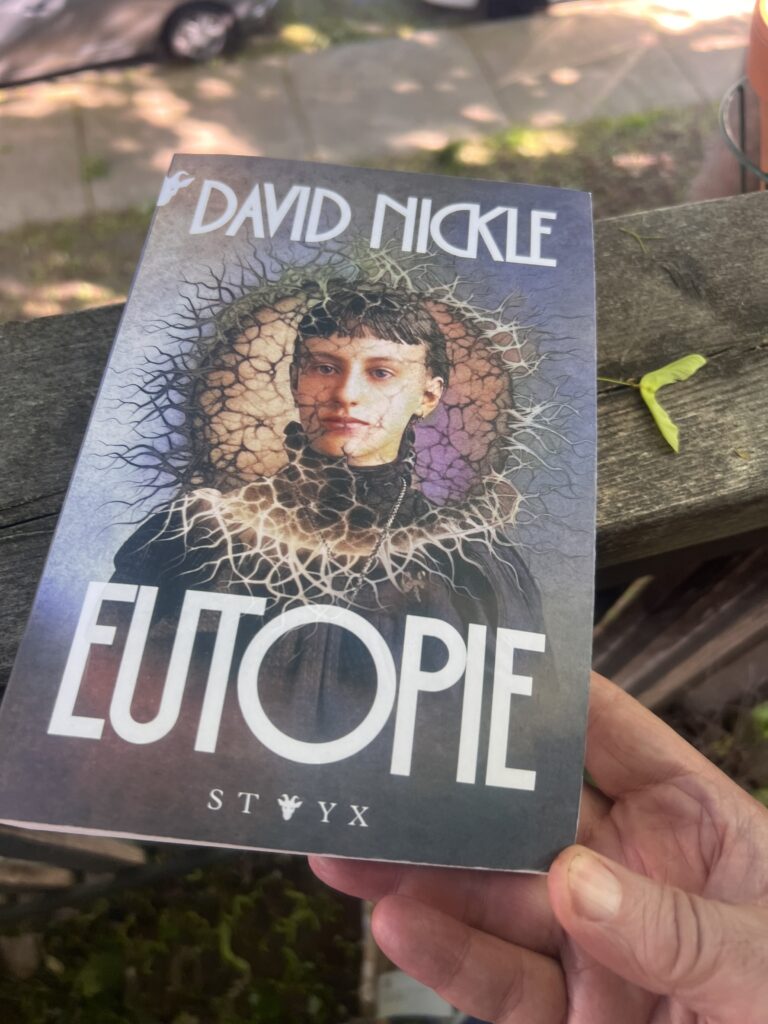
Eutopie est disponible en France, et je suis ravi de voir mon ancien roman d’horreur sur l’eugénisme, la religion et l’expérience américaine trouver un nouveau public parmi les lecteurs francophones.
If only my deplorable Ontario high school French were up to the task of continuing this article en français.
So stepping away from Google Translate, and into English:
My novel Eutopia: A Novel of Terrible Optimism is now available in France as Eutopie, from Fleuve Styx in an excellent translation by Laurent Filibert-Callait. I’m delighted to see how the book, originally published in 2011 in Canada, reads in 2026, to French readers in France and the EU.
I suspect, with considerably less delight, that given our current geopolitical environment, this novel about the birth of the American eugenics movement, bad religion and catastrophic epidemics might have arrived at a very unfortunate zeitgeist moment.
Of course, I thought the same thing in the early 2000s, when I picked up Edwin Black’s exhaustive history of the American eugenics movement, War Against The Weak and looked around at that geopolitical environment, and and concluded:
In a world where the U.S. was responding to a terror attack with bombs and torture prisons, where Americans were responding with an unprecedented level of Islamophobia… Where white supremacists were not precisely in charge, but were definitely gaining traction…
Now is the time.
Eutopia was released in 2011, through ChiZine Publications in Canada, and for a boutique Canadian press the novel did well. We subtitled it “A Novel of Terrible Optimism” – which was a reference to the twisted utopianism that I saw to be inherent to the early eugenicists’ self-stated mission. Operating on the assumption that societal ills could be mapped on to genetic expression, proceeding by the crude notion that culling “the weak,” or at least preventing those individuals from bearing children would eliminate those ills…

Monsters like Charles Davenport, who founded the Eugenics Records Office in 1910 and became one of the pseudoscience’s strongest proponents, could reasonably consider themselves to be the opposite: social engineers, building a better society for all.
Charles Davenport is a presence in Eutopia, but not a direct antagonist. The novel takes place in the fictional Idaho mill town of Eliada, established as a utopian experimental community by an early-American industrialist, and based on the three pillars of Community, Compassion… and Hygiene. Garrison Harper is a eugenicist, but he has something else up his sleeve: an organism that the eugenicists on-site have horribly mis-named Mister Juke, after the Jukes family of supposedly congenital criminals, paupers and atheists, that served as poster-children for the early movement thanks to an 1874 study by sociologist Richard L. Dugdale.

The Juke in Eutopia was inspired a bit by the creations of American horror and weird fiction author H.P. Lovecraft, although not directly. The novel itself on the other hand…
One of my chief aims in the mid-2000s was to write this novel to be in a kind of oppositional dialogue to Lovecraft, specifically to the intense racism and xenophobia that animated many of his stories within The Cthulhu Mythos. I didn’t want to use his mythos to do so, but I did want to use the true history of the movement to critique it.
I will note that I was both early and late to the game. By the time Eutopia came out, Michel Houellebecq’s essay on the subject, H.P. Lovecraft: Against The World, Against Life was 20 years old. A few years after Eutopia hit shelves, Victor Lavalle’s excellent novella The Ballad of Black Tom took on one of Lovecraft’s most odiously xenophobic stories “The Horror at Red Hook,” and Matt Ruff’s Lovecraft Country drew a direct line between Lovecraft’s racist stories by setting Lovecraft Country in the heart of Jim Crowe America. All of these books took on the old man from Providence’s texts directly, and did so with a lot more rigorous than the side-eye critique I delivered through Eutopia.
(I am, incidentally, unabashedly delighted to note that Eutopie’s translator Laurent Filibert-Callait also translated Lovecraft Country into French)
One of the things that struck me about Lovecraft, though, was how effective he was at channelling and nurturing a white-supremacist vibe in horror fiction – the way he had made the assumptions and anxieties of the early eugenicists so central to the effect in much of his fiction. In the pulp milieux of the early 20th century, he was certainly not alone in this regard.
A hundred years later, it’s becoming clear that Lovecraft is far from alone. The horror show that Charles Davenport helped start, that Nazi Germany imported, that continued through the atrocities of forced sterilization and genocide seem to be reaching another crescendo. Not so much in horror and weird fiction – Lavalle and Ruff and others have seen to that – but nearly everywhere else, and in places of power that had until now been at least somewhat insulated.
Eutopia’s been in print in English since its publication – briefly falling out of print in 2019, when ChiZine ceased operations, but back in print now with Open Road Media. There’s a sequel, Volk, and it’s available too, in English.
And now, thanks to Fleuve Styx and the interest of its director Laurent Queyssi, the work of translator Laurent Philibert-Callait, Eutopie is out in French.
Perhaps now, once more, is the time.